Spend It or Lose It
 Written by
Brian Buck
| 09/25/2026
Written by
Brian Buck
| 09/25/2026
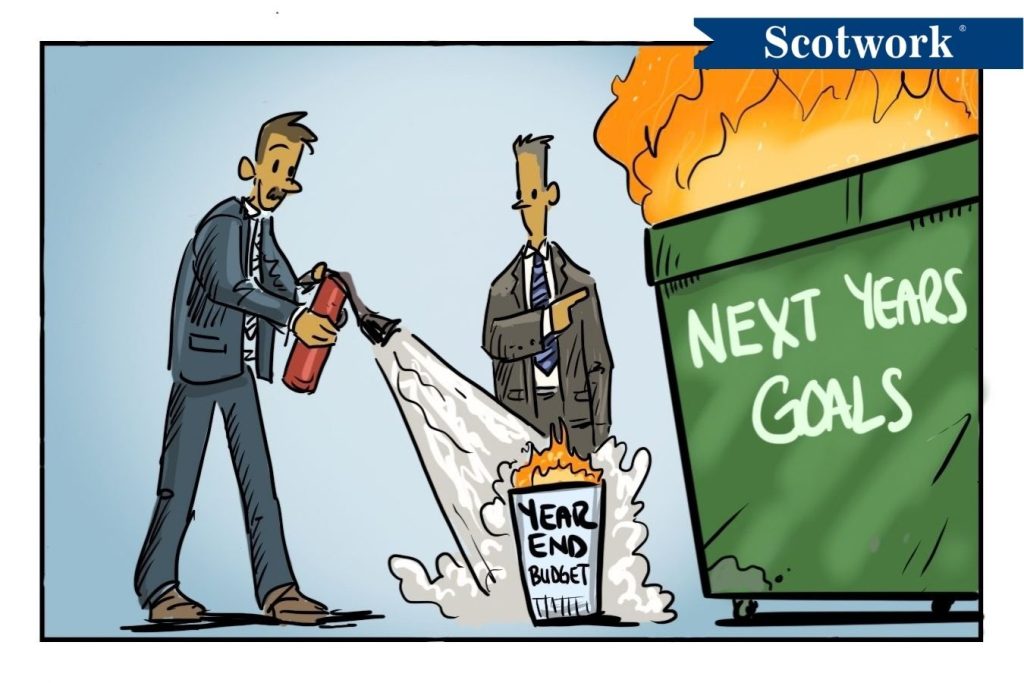
As Q4 begins, many companies start thinking about how to wrap up the year and plan for the next. This is also when “spend it or lose it” budget conversations happen as a result of corporate governance, budgeting rules, and human nature. These conversations don’t always lead to the best outcomes.
Researchers at Harvard and the University of Chicago studied year-end federal contract spending. They found that agencies spend nearly five times more in the last week of the fiscal year than in a typical week, and the quality of what they buy declines.
Those agencies weren’t being careless. They were following the rule: use the money or lose it. When the clock runs down, the question shifts from “What do we need?” to “What can we get approved by Friday?”
This is the case with many of our clients. Some have budget they need to spend by December 31; others are salespeople looking for customers who must spend their budgets. If you’re not careful, time constraints can take priority over the real objectives of a deal.
Recently, one of our clients showed me what it looks like to handle this situation with skill.
He’s a sales leader who called a customer to talk about planning. Early in the call, he learned there was budget that had to be spent. As a good partner, he tried helping them determine how to use it, but this customer had some big goals that weren’t going to be accomplished by December 31. In fact, some stretched well into next year.
He started asking questions: “What are you trying to accomplish, and what’s standing in the way?” “What exactly could this money be used for, and what can’t it?”
He learned that this year’s money couldn’t pay for next year’s services. But if the program started this year and carried into next, the customer could combine what remained of this year’s budget with next year’s and commit to a longer-term program. He used today’s problem to explore tomorrow’s possibilities.
Here are 5 ways to keep the calendar from stealing your power . . .
1. Don’t just put out the fire.
Urgent isn’t the same as important. When someone says, “We have to spend this by year-end,” the easy response is to help them spend it. The better response is to ask what they’re trying to accomplish.
2. Find the edges of the constraint.
“Use it or lose it” sounds absolute. Usually, it isn’t. Ask what the money can be used for, what it can’t, who decides, and what’s been done before.
3. Run the March test.
Before you agree, ask yourself, Would I do this deal, at this price, on these terms, with this scope in March? If the answer is no, then the deadline is driving the decision, not the value.
4. Trade timing, not price.
Year-end pressure usually runs both ways. The buyer’s budget is expiring, and the seller’s quota deadline is nearing. That makes timing valuable, so trade it.
5. Know the real deadline for year-end.
Procurement cutoffs, approval chains, and holiday calendars advance the must-close date into early December — or even sooner. Sellers who map the approval path make it easy for customers to say yes. Buyers who wait make decisions under duress.
Year-end deadlines push both sides toward short-term thinking. Skilled dealmakers know how to focus on value even when the clock’s running out.
Negotiation Training and Consulting to Get Your Greatest Value Even When the Clock’s Running Out.
Rely on Scotwork’s expertise to help you address your key priorities even under time pressure.
Get in touch with one of our experts today.
Frequently Asked Questions
Is it wrong to spend leftover budget before year-end?
No. Leftover budget can fund real priorities. It becomes a problem when the deadline, not the need, drives the decision.
Should I tell a vendor I have budget I need to spend?
It’s OK to share the need, just not how badly you need it. For instance, if what you share is that you have to spend the money, that urgency gives the seller more leverage than the deal probably deserves. So, share the need, not the urgency.
How can sellers help a customer with expiring budget without discounting?
Get curious about what the customer is trying to accomplish beyond year-end, and make it easy to say yes. Structure the offer around their approval process and constraints, and trade flexibility on timing for a longer-term commitment.
Can this year’s budget be used for next year’s work?
It depends on the organization’s rules. Some can’t prepay future services but can fund a program that starts this year and continues into next. Ask Finance or Procurement what’s allowed before you presume the answer.
What if our fiscal year doesn’t end in December?
The same dynamics apply at any year-end. Learning your counterpart’s fiscal calendar should be part of your preparation.
Similar articles
By Brian Buck | 11.09.26
Your Renewal Just Got Flagged
Recently, I worked with a large sales team that showed me something they’d built: an…

By Kirbi Isaac | 07.08.26
Don’t Make Them Guess
A friend and I recently went out to dinner and had a great meal. We…

By Brian Buck | 10.07.26
Improve Internal Negotiations: Be a Creator
In my position, I’m frequently asked some variation of the following question: “How do I…